
Category: Research
-

Audio and podcast
My journey into audio did not begin as a technical choice, or even as a conscious design strategy. It began with discomfort. Again and again, in my research and teaching, I saw how effortlessly text positioned itself as the default. Instructions, consent forms, rules of play, explanations of systems — all written, all assumed readable.…
-
Positon paper
Version december 8th after rewrite based on feedback from lector Maaike Harbers Giving Voice Beyond Literacy Introduction My design research explores how visual and experiential communication can bridge the gap between literate and non-literate people. It is situated within the discourse of inclusive and participatory design, but expands these frameworks by focusing explicitly on those…
-

Introducing time to the game board
Third iteration The redesign of the game board and gameplay mechanics was undertaken as a research-through-design (RtD) iteration, in which design practice itself functioned as a mode of inquiry. Rather than treating the game as a final artefact to be refined or optimised, each iteration was approached as an opportunity to investigate how systemic complexity,…
-
Development of the game board
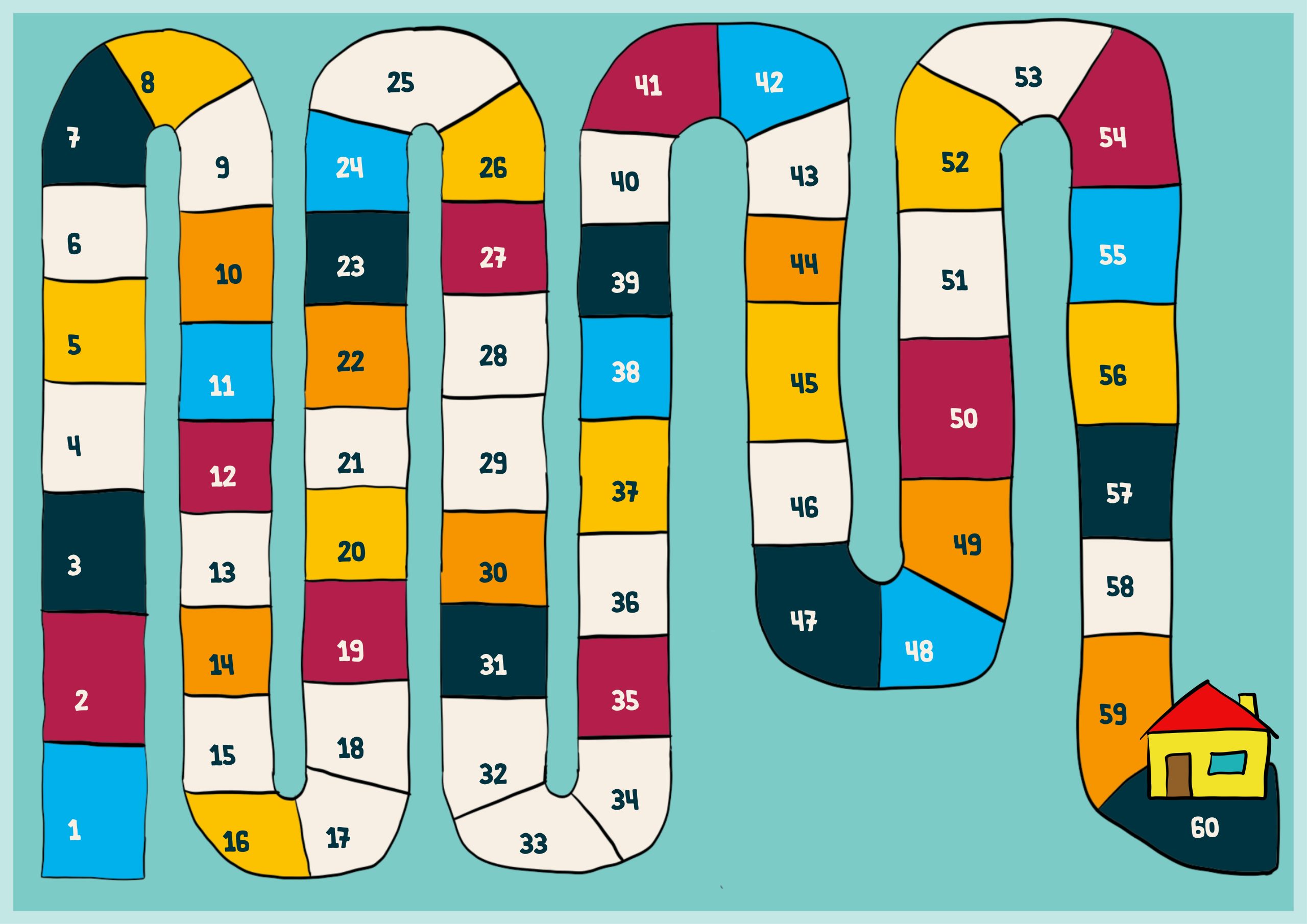
Second iteration In an earlier design iteration, prior to the final redesign, the game board was significantly simplified as an exploratory move within the research-through-design process. Rather than embedding actions directly on the board, these actions were externalised and transferred to card-based interactions. This shift allowed the board to function primarily as a navigational structure,…
-

How a game became a movement
Living Without Letters is more than a research project. It is a message that continues to travel — through Rotterdam and beyond. Through this work, I became part of the Digital Social Innovation Lab (DiSIL). Their initial focus was entirely on digital literacy. But by entering the lab, I brought a different reality into the…
-
Feedback from experts
Following playtests of the first and second game iterations, feedback was provided by Dieuwertje Schuur MSc, an expert in interaction design and play. She observed that the use of dice as the primary mechanism for determining both movement and action significantly limited players’ ability to influence their progression in the game. Because outcomes were largely…
-
Audio files
Dutch Start van het spel Uitleg luidspreker symbool Brieven Brief 1 Brief 2 Brief 3 Brief 4 Brief 5 Brief 6 Eisen pasfoto Uitleg paspoort Weet jij waar ik een paspoort kan aanvragen? Antwoord buurman: Wat kost een paspoort? Wanneer is een paspoort klaar? Instructies sociale huurwoning English Start of the game Letters Letter 1…
-
Living atlas
This Living Atlas is not a conclusion. It’s a beginning—an unfinished map made through co-creation, friction, failure, and wonder. By sharing this work, I aim to support others in noticing what often goes unseen, unheard, and unread. Let’s build a world that includes everyone.
-
Essay on results until may 2025
Designing for Inclusion: Learning from Illiteracy-Focused Experiments A short essay on competencies in socially engaged design research Introduction In a world increasingly mediated by complex information systems, those who cannot read or write are systematically excluded. As design researchers, we have the responsibility—and the tools—to design with empathy, through participation, and for transformation. This short…