
How can participatory design be used to create inclusive, empathy-driven experiences that challenge literacy-based exclusion and empower non-literate individuals as co-creators of knowledge and social change?
This research originates from a sustained sense of injustice in how people who struggle with reading and writing are perceived and treated within contemporary society. These attitudes are not incidental; they are rooted in deeper societal values that privilege textual competence as a prerequisite for autonomy, participation, and citizenship. As a result, people who cannot engage confidently through written language are often positioned as deficient, dependent, or invisible within public systems.
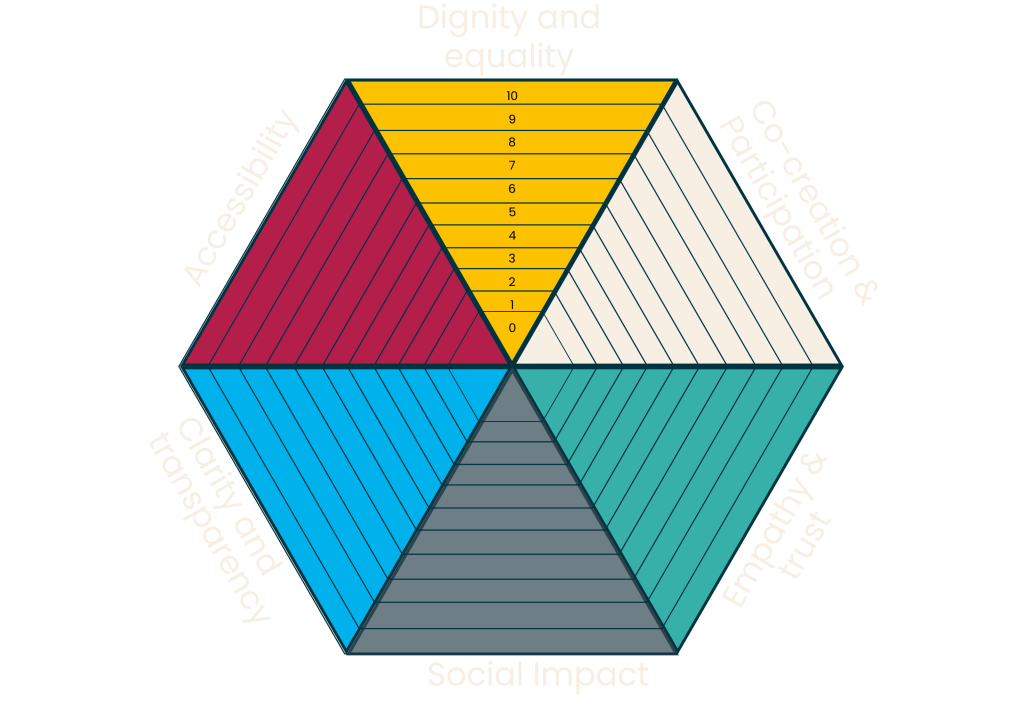
View a prototype of the working hexagon with the button below.
The board game was developed as a research-through-design instrument to make this injustice experientially tangible. Rather than explaining exclusion conceptually, the game invites participants—many of whom may never have reflected on these issues—to experience the consequences of literacy-dependent systems firsthand. Through play, participants encounter delays, confusion, dependency, and moments of exclusion that mirror the lived realities of people with limited literacy, often without initially recognising the broader implications.

Not a one off type of research
To ensure that this experience does not remain a one-off emotional encounter, the game is combined with a hexagon-based value mapping tool. During and after gameplay, participants repeatedly fill in the hexagons to identify and reflect on the values that are affected throughout the game—such as autonomy, dignity, fairness, trust, and participation. This repeated mapping serves two purposes. First, it makes implicit value violations explicit, translating experiential moments into articulated ethical insights. Second, it allows changes in awareness and perspective to be tracked over time, transforming affective responses into reflective understanding….
By integrating the hexagons structurally into the gameplay and reflection process, the research investigates whether explicitly naming and revisiting affected values contributes to a more durable impact. The central question is whether this combination of embodied experience and value articulation can move participants beyond momentary empathy toward sustained awareness and responsibility in their professional and civic practices.
The development of this research set-up is itself a co-creative process, carried out in collaboration with partners from the Digital Social Innovation Lab, the Social AI Lab, the research centre Creating010, the Digital Social Innovation learning and working community, and various domain experts. These collaborations ensure that the game and the hexagon methodology are informed by diverse perspectives and situated within real societal contexts, thereby increasing both relevance and impact.
In addition, the game and accompanying value-mapping tools are embedded within a series of educational modules on inclusive design and development within CMI’s cross-domain education programme. This educational integration allows the research to extend beyond isolated interventions and become an ongoing practice. Students are not only exposed to the outcomes of the research but actively participate in its continuation, learning to design with and for inclusion as part of their professional formation. In this way, the research functions simultaneously as inquiry, advocacy, and pedagogy—contributing to the training of a new generation of designers and technologists who are equipped to recognise and challenge systemic exclusion in their future work.
Jitske Kramer on values and the connection to this research
In her video, Jitske Kramer speaks about values not as abstract words on a wall, but as something that only becomes real through action, friction, and choice. Values, she suggests, reveal themselves precisely when they are under pressure: when time is scarce, when interests collide, when people have to decide what really matters. It is not what we say we value, but what we do when it becomes uncomfortable, costly, or unclear.
This perspective strongly resonates with my research and with the way I work with hexagons as a research and design instrument.
Values are not neutral — they are enacted
Kramer emphasises that values are collective agreements that live in behaviour. They are shaped in interaction, negotiated in context, and constantly redefined. This aligns with a core insight in my research: exclusion around low literacy is rarely caused by a lack of empathy or “bad intentions,” but by systems that silently prioritise certain values over others. Efficiency over care. Speed over understanding. Uniformity over dignity.
These priorities are often invisible — especially to those who benefit from them.
The hexagon as a space for friction
In my work, the hexagon functions as a visual and experiential mapping tool for values. Each point of the hexagon represents a value that is at stake in a system or situation — such as autonomy, equality, efficiency, safety, participation, or trust. Participants are asked to repeatedly position, adjust, and reconsider these values while playing the game or reflecting on an experience.
This repeated filling-in of the hexagon is crucial. It mirrors exactly what Kramer points to: values are not fixed. They shift depending on context, power relations, and pressure. When participants experience a system without written language — or when literate participants suddenly lose access to text — the hexagon starts to change shape. Values that once felt “balanced” become distorted. What seemed efficient may suddenly feel unjust. What felt neutral reveals itself as excluding.
Making values visible, without words
Kramer’s work often shows how cultural norms remain invisible until they are disrupted.
My research aims to do something similar, but without relying on text. By working with shapes, spatial positioning, repetition, and discussion, the hexagon allows values to surface in a way that is accessible to people who cannot easily read or write.
This is not about simplifying values, but about making them tangible.
Participants do not have to name values correctly. They feel them. They argue about them. They see how one value grows at the expense of another. And, importantly, they see that these are not personal failures, but systemic choices.
From one-time insight to lasting awareness
A key question in my research is whether explicitly mapping values — again and again — can prevent insight from being a one-off emotional moment. Kramer warns that values easily become empty language if they are not actively maintained. The hexagon responds to this risk by demanding return, reflection, and recalibration. Each round asks: Is this still what we find acceptable? Who benefits? Who pays the price?
In that sense, the hexagon is not a diagnostic tool, but a moral rehearsal space.
Shared responsibility
What I take from Jitske Kramer’s video is a confirmation that working with values is not about consensus or comfort. It is about staying with the tension long enough to learn from it. By embedding values explicitly into the game mechanics and visual mappings, my research shifts responsibility away from individuals who “struggle” and toward the systems that silently encode what — and who — counts.
The hexagon makes that visible.
And once values are visible, they can no longer be ignored.
Collaboration partners
Digital Sociaal Innovation Lab
To research and learn how digital (AI) applications can contribute responsibly and sustainably to the social quality of life of people in the city, a neighborhood lab has been developed: the Digital Social Innovation Lab (DiSIL). Researchers, teachers, students, and pupils from primary schools to universities collaborate in DiSIL with local and national government officials, civil society organizations, and volunteers who advocate for citizens’ interests, as well as with local key figures in the neighborhood who can involve individual citizens in activities.
DiSIL aims to strengthen the position of citizens in the debate about designing AI applications in systems they encounter as citizens, thus contributing to a sustainable and inclusive city. This involves not only research and learning but also the design and creation of digital applications that concretely and positively impact the lives and experiences of people in the city.
Source: https://www.hogeschoolrotterdam.nl/hogeschool/missie-visie-en-strategie/slimme-en-sociale-stad/digitale-sociale-innovatie/
Sociaal AI Lab
In Rotterdam, we want everyone to be able to participate in the digital society. That’s why we now have the Social AI Lab Rotterdam: an open space in the city where residents, researchers, designers, and policymakers collaborate on fair, understandable, and accessible technology.
Through discussions, meetings, learning, and hands-on activities, Rotterdam residents discover what AI means for their daily lives and contribute their ideas about what technology should and shouldn’t do.
Source: https://sociaalailab.nl/
Creating010
Creating 010 is a Research Centre that focuses on transformations in society that are related to ongoing digitisation and to developments in the field of information and communication technology. Creating 010’s research always considers people within their social context. Designers, developers and appliers of technology all play an important role in this regard; the choices they make allow them to address the often difficult challenges posed by technology, for example by opting for secure data storage and open source software. They are also in a position to shape future developments, by considering the needs of users, stakeholders and society at large in the design of not only products and services, but also shopping districts and cities. This is also the perspective from which Creating 010 contributes to the development of innovative educational concepts.
Another important consideration is how ICT and digitisation can facilitate the development of networks of individuals, organisations and businesses, thus promoting further innovation and development. This is why Creating 010 also researches new models for realising in practice the added value of networks for citizens, institutions and businesses.
The main sectors we consider are the creative industry and ICT, both of which play a key role in defining the form and content of transformations in sectors such as social care and healthcare, entrepreneurship, retail, and urban development. Creating 010 collaborates closely, though by no means exclusively, with the Institute for Communication, Media and Information Technology (CMI) and the Hub: Technology (HR WERKplaats Techniek). Creating 010 approaches its research themes from an interdisciplinary perspective, often in collaboration with social partners, educational institutes and research centres within and outside the Rotterdam University of Applied Sciences.
Source: https://www.rotterdamuas.com/research/research-centres/creating-010/about-our-research-centre/
Learning-working community: Digital and social innovation
Digitalization has a huge impact on people and society. But not everyone benefits equally from the range of digital products and services. Rotterdam University of Applied Sciences strives to ensure that digitalization will no longer be a cause of social inequality in the near future and strives to use it positively and constructively to improve the social quality of life for the city’s residents.
In the learning community, social partners, educational institutions, research, and participants come together to explore solutions. Our goal is to challenge familiar patterns and ideas by allowing these different groups, each from their own perspective, to co-create for the benefit of the city of Rotterdam and its residents.